

Marin County Real Estate Market Report
September 2026
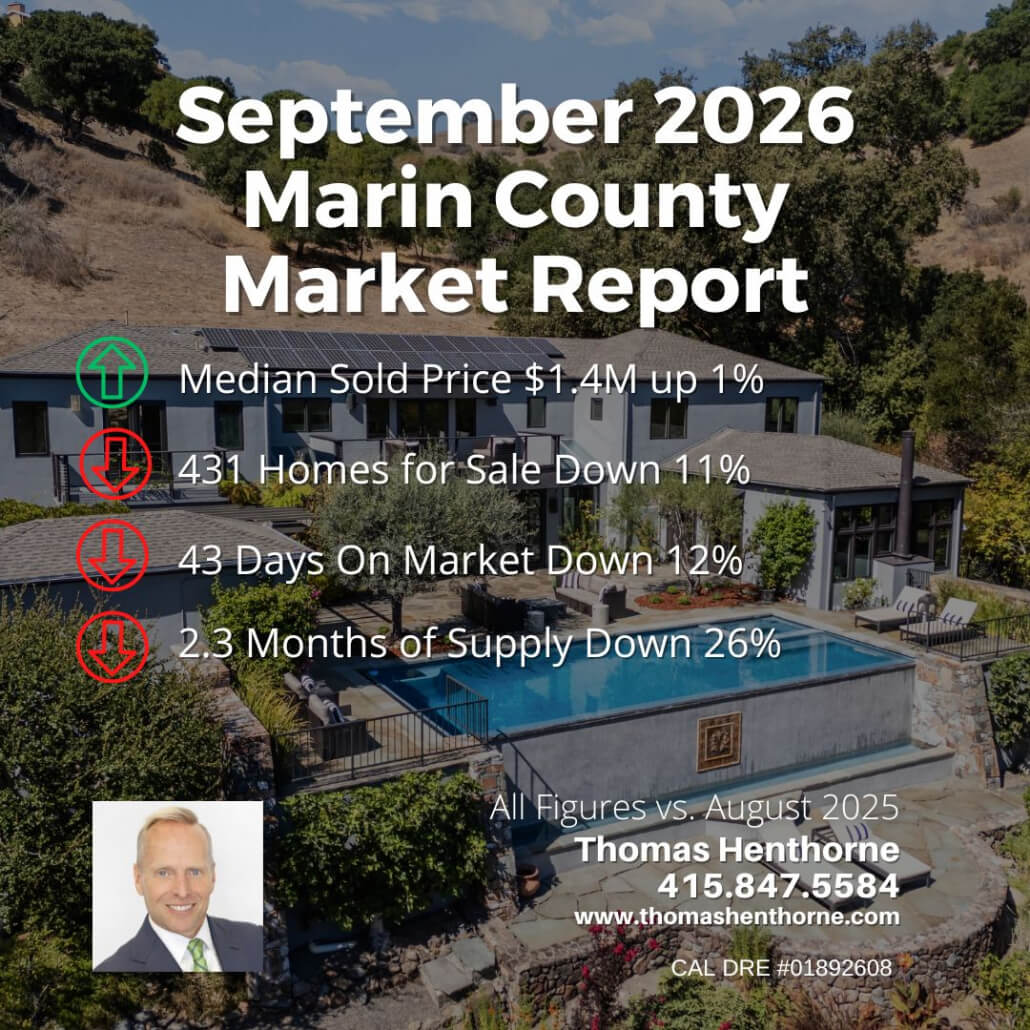
September 2026 Marin Real Estate Market Report: 4 Key Takeaways
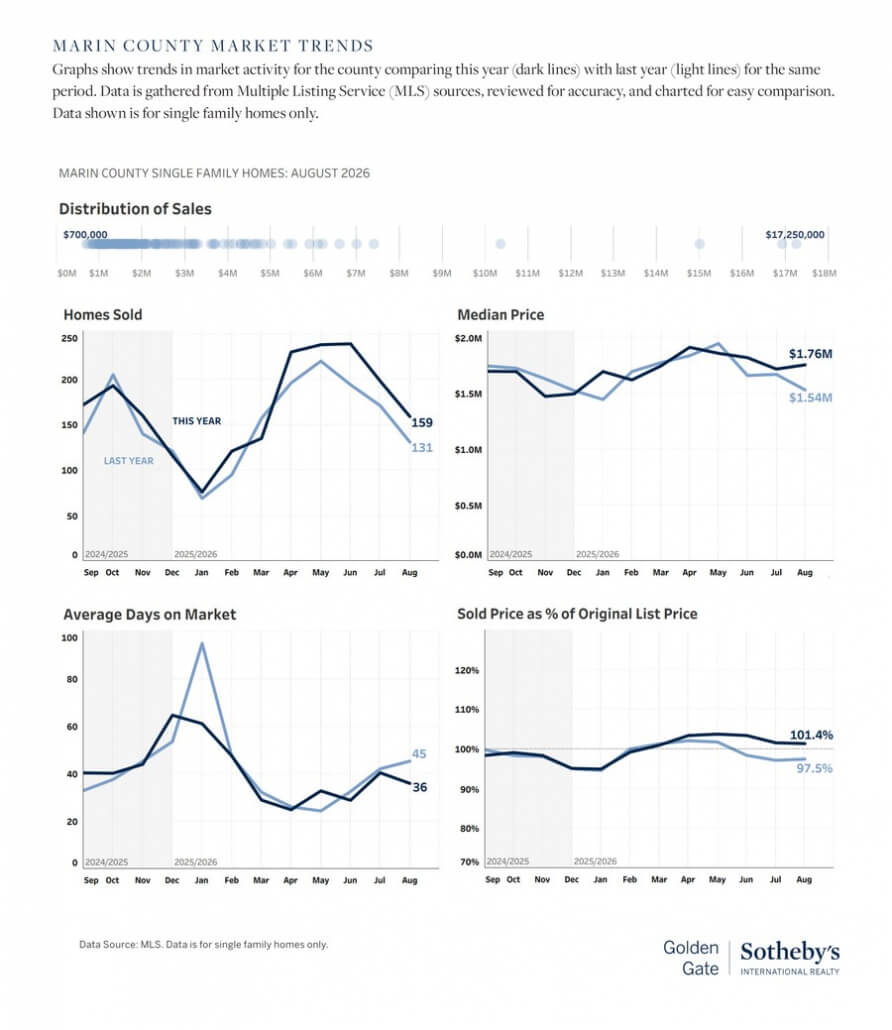
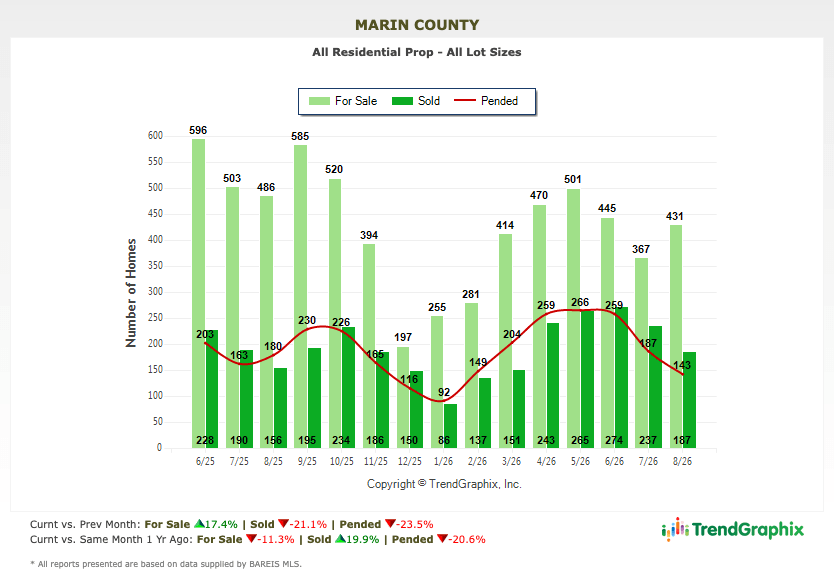
Sales Were Up, But The Market Is More Selective. Marin recorded 187 closed sales, up 19.9% year over year. That is a strong absorption signal, but pending sales fell 20.6%, suggesting that buyer activity remains present but more uneven heading into fall.
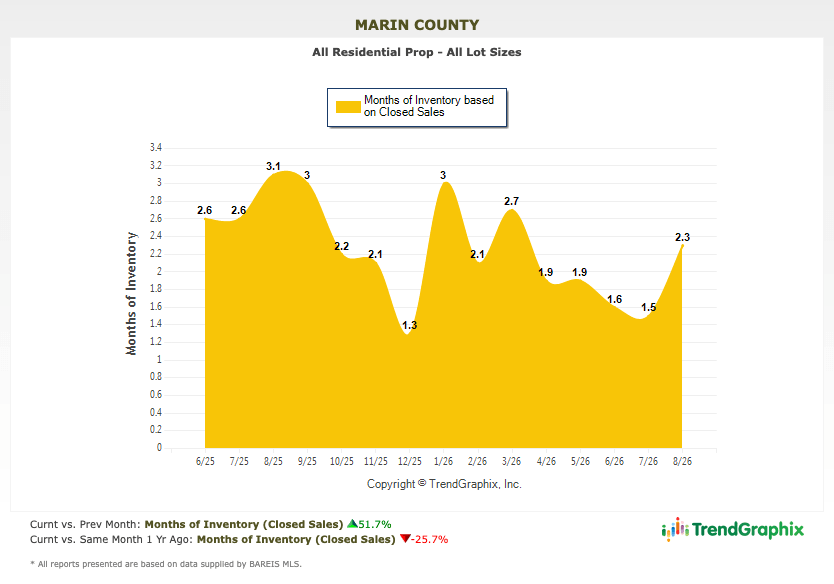
Inventory Is Still Lower Than Last Year. Marin had 431 homes for sale, down 11.3% year over year. Months of inventory was 2.3, down 25.7% from the same month last year, keeping Marin well below a balanced market.
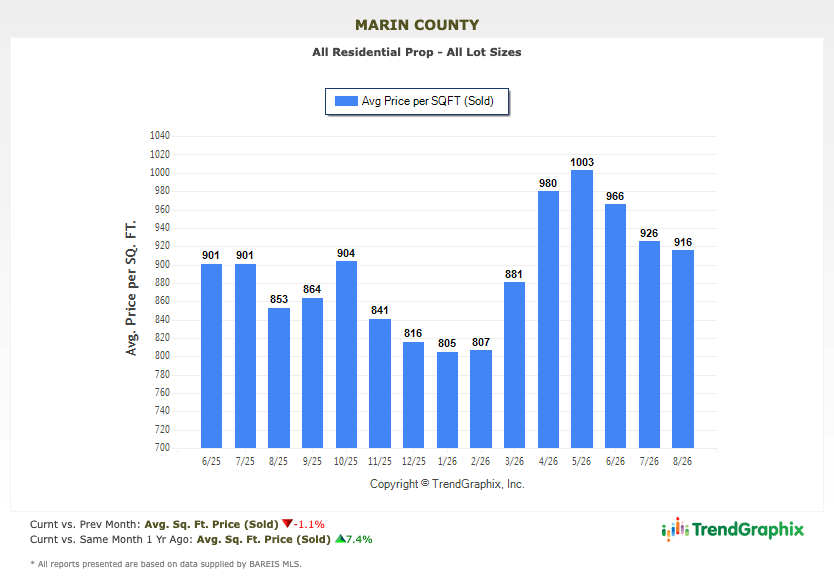
Pricing Was Stable To Modestly Higher. The median sold price was $1.4 million, up 0.7% year over year. Average sold price rose 2.7% to $1.846 million, while average sold price per square foot increased 7.4% to $916.
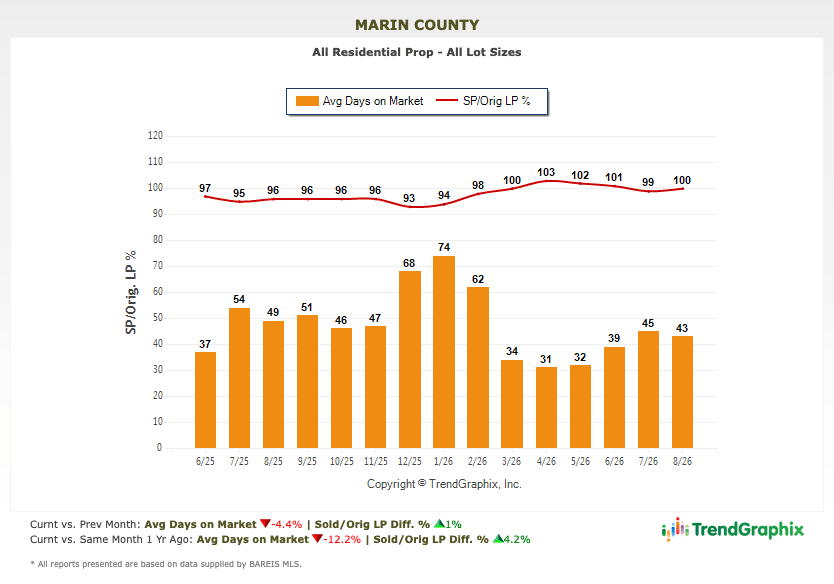
Homes Sold Faster And Closer To Asking. Average days on market fell 12.2% year over year to 43 days. Homes sold at 100% of original list price on average, up 4.2% from last year, showing that well-positioned homes continue to command attention.
Here’s The Latest Update On The Marin County Real Estate Market
The September report shows a Marin market that remains fundamentally healthy, even as we move out of the strongest part of the spring and early-summer selling season. Closed sales increased meaningfully year over year, pricing held firm, homes sold faster, and the sold-to-original-list-price ratio improved.
That strength is especially notable because August is traditionally one of the quieter months for Marin real estate. Travel schedules, school transitions, and late-summer timing often soften activity, but this year’s August data showed continued underlying strength. Compared with August 2025, closed sales rose 19.9%, inventory fell 11.3%, months of supply declined, homes sold faster, and the median sold price edged higher.
The broader Bay Area backdrop also matters. The Bay Area economy remains strong, optimism is high, and the continued creation of wealth — particularly around AI, technology, and related industries — is helping support buyer sentiment. This month’s report looks at seasonality, pricing power, fall inventory, buyer selectivity, and the Bay Area wealth trends shaping Marin demand.
The clearest theme remains supply. Marin had 431 homes for sale, down 11.3% from the same month last year, and months of inventory was 2.3, down 25.7%. That is still a relatively tight market, especially compared with national conditions.
Pricing was steadier than explosive. The median sold price rose only modestly to $1.4 million, up 0.7% year over year, but average sold price and price per square foot both moved higher. That suggests continued strength in the quality segment of the market, even as buyers remain careful.
Buyer behavior remains nuanced. The average home sold at 100% of original list price, a significant improvement from last year, and days on market declined to 43. At the same time, pending sales were down 20.6%, which suggests that the next wave of demand is more selective.
In practical terms, Marin is not an overheated market where every listing sells easily. It is a disciplined market where preparation, pricing, presentation, and property quality matter. Homes that align with buyer expectations can still perform very well. Homes that miss on price or require significant work may need more time.
Key Year-Over-Year Metrics For Marin County
- Median sold price: $1.4 million, up 0.7%
- Average sold price: $1.846 million, up 2.7%
- Average sold price per square foot: $916, up 7.4%
- Homes sold: 187, up 19.9%
- Pending sales: 143, down 20.6%
- Homes for sale: 431, down 11.3%
- Months of inventory: 2.3, down 25.7%
- Average days on market: 43, down 12.2%
- Sold to original list price ratio: 100%, up 4.2%
What This Means For Pricing Power
Pricing power remains present in Marin, but it is not universal.
The overall data still leans in favor of well-prepared sellers. Inventory is lower than last year, months of supply remains constrained, closed sales are higher, homes are selling faster, and the average sale is reaching 100% of original list price.
At the same time, the modest increase in median sold price and the decline in pending sales suggest that buyers are not chasing every listing. They are comparing value carefully, paying attention to condition, insurance considerations, remodeling needs, privacy, views, outdoor living, and proximity to amenities.
For sellers, the takeaway is that the market rewards accuracy. Pricing too aggressively can still create resistance, even in a low-inventory environment. For buyers, the market offers more nuance than the headline numbers suggest. The best homes can still move quickly, but there may be negotiating room where a property is overpriced, needs work, or lacks a clear buyer narrative.
Supply And Demand Heading Into Fall
Marin enters the fall market with less inventory than last year, but with buyers showing more discipline.
August is traditionally a slower month for Marin real estate. Many buyers and sellers are traveling, families are focused on the start of school, and some homeowners wait until after Labor Day to bring new listings to market. So a late-summer slowdown is not unusual. In fact, it is part of the normal rhythm of the Marin market.
That makes the September market especially important. September often acts as a mini spring season in Marin, with a fresh wave of listings coming to market before activity typically quiets again after October. I am already seeing that pattern begin, with new inventory starting to appear.
The 19.9% increase in closed sales is encouraging and shows that buyers are still transacting. But the 20.6% decline in pending sales is worth watching. It may reflect August seasonality, a smaller pool of compelling new listings, buyer caution around rates and affordability, or simply a more selective late-summer market.
The supply picture still favors sellers in the aggregate. With 2.3 months of inventory, Marin remains below the level generally associated with a balanced market. But the experience of selling a home will depend heavily on price point, location, condition, preparation, and the depth of the buyer pool for that specific property.
After October, the Marin market typically becomes quieter as we move toward the winter months. That can create challenges for sellers who miss the fall window, but it can also create opportunities for wise buyers. Some of the best values appear when competition thins, motivated sellers remain in the market, and overlooked properties have time to be reconsidered.
As we move into fall, I will be watching whether new inventory improves, whether pending sales recover, and whether Bay Area wealth continues to support the upper end of the Marin market.
Real Estate News Nationally
Nationally, the housing market remains slower and more inventory-heavy than Marin. The National Association of REALTORS reported that August existing-home sales fell 1.2% year over year to a seasonally adjusted annual rate of 3.98 million. National inventory rose to 1.62 million homes, equal to a 4.9-month supply, while the national median existing-home price rose 1.6% year over year to $429,100. NAR also reported that the average 30-year fixed mortgage rate was 6.67% in August.
That national backdrop matters because it continues to shape buyer psychology. Higher mortgage rates, affordability concerns, and increased inventory in many parts of the country are giving buyers more leverage nationally. Marin is different, but not immune. Buyers here may have more equity, liquidity, or wealth-driven purchasing power, but they are still value-conscious.
The contrast with Marin is striking. Nationally, supply is at 4.9 months. In Marin, months of inventory was 2.3. That helps explain why Marin can still show relatively strong pricing and absorption even while the national market feels more constrained by affordability.
Greater Bay Area Context
The Bay Area continues to behave differently from much of the national market, especially in San Francisco and parts of the Peninsula.
Redfin reported that San Francisco was one of the strongest major metro markets in August, with median sale price up 7.5% year over year, home sales up 9.5%, and active listings down 10.1%. By contrast, San Jose showed a more mixed pattern: median sale price was down 2.0%, while new listings rose 25.5% and active listings rose 17.7%.
That split is important for Marin. The AI wealth effect appears most visible in San Francisco and the Peninsula/Silicon Valley corridor, but the Bay Area is not moving as one uniform market. Some markets are tight and competitive; others are seeing more inventory and more buyer choice.
Golden Gate Sotheby’s Q2 San Francisco market update also showed significant strength in San Francisco earlier this year, with a $1.7 million median sales price, up 13% year over year, closed sales up 20%, average days on market down 26%, and inventory down 47%.
For Marin, the broader takeaway is that regional wealth remains a meaningful tailwind, but it is not evenly distributed. Homes with privacy, views, architectural interest, outdoor living, and a lifestyle upgrade story are best positioned to benefit.
Bay Area Real Estate News
The biggest Bay Area real estate story continues to be the concentration of AI-driven wealth in San Francisco and the Peninsula.
The San Francisco Chronicle reported that all-cash purchases accounted for roughly 30% of sales in the San Francisco metropolitan area from April through June, using Redfin data. The same article noted that AI-related wealth has helped some buyers compete aggressively for a limited number of homes in expensive Bay Area neighborhoods.
That does not prove that AI money is flowing north into Marin in a measurable way yet. Public data is better at showing what is happening in San Francisco, San Mateo, and San Jose than it is at identifying where individual buyers go next.
But the logic is clear. When wealth is created in San Francisco and the Peninsula, Marin often becomes a natural consideration for buyers seeking more space, privacy, outdoor living, schools, views, and a quieter residential lifestyle. That is especially true for buyers who can work remotely or hybrid and do not need to be in San Francisco or Silicon Valley every day.
The AI wealth effect should be understood as a tailwind, not a guarantee. It can support upper-end demand and buyer confidence, but it does not override fundamentals. Pricing, condition, location, insurance, architecture, and lifestyle still determine outcomes.
In My World

I just launched 56 Miwok Drive in San Anselmo, a rare opportunity to enjoy resort-like living in one of Marin’s most sought-after communities.
Set on just over an acre with sweeping hill and valley views, this Mediterranean-style estate offers exceptional privacy, generous scale, and a strong connection to the outdoors. The property features five bedrooms, four full baths, approximately 4,475 square feet, multiple living and entertaining spaces, a separate one-bedroom guest apartment, and an infinity pool and spa.
The setting is especially compelling: a private drive, landscaped motor court, mature gardens, outdoor living areas, and exceptionally easy access to nearby hiking trails, including Sorich Park and the Ridgewood Fire Trail. It is a property that feels wonderfully removed from everyday life while remaining close to Red Hill Shopping Center, downtown San Anselmo, schools, and the best of Marin living.
Looking Forward
The September report points to a Marin market that is still healthy, but increasingly selective as we move from the slower August period into Marin’s short fall selling season.
The positive signals are clear: closed sales are up, inventory is lower, months of supply is down, homes are selling faster, and the sold-to-original-list-price ratio has improved. Those are meaningful indicators of continued demand.
The cautionary signal is pending sales. A 20.6% decline in pending activity suggests that fall momentum should be watched carefully. If new inventory improves and buyers respond, the market could remain steady. If pending sales remain soft, sellers will need to be especially disciplined on pricing and preparation.
For now, Marin remains well positioned compared with many national markets. Supply is still constrained, regional wealth remains a factor, and distinctive homes with strong lifestyle appeal continue to stand out.
This is not a market where every listing sells easily. But it is a market where the right property, properly prepared and correctly positioned, can still generate excellent results.
How Can I Help?
I’m always happy to talk about the Marin County real estate market. Call or text me at 415-847-5584 for a personalized report for your home and neighborhood, or to discuss the best strategy for making your dream home a reality.
Now Available!

Exclusively Offered for $4,395,000
Swipe to See More Homes


Check Out My Sizzle Reel!
From the Golden Gate Sotheby’s Bay Area Market Report…
STRONG SUMMER MARKET
The San Francisco Bay Area housing market capped off a strong summer buying season in August, bolstered by economic gains and growing competition for quality homes. Total employment increased by nearly 24,000 jobs year-over-year, while the unemployment rate tightened by 40 basis points to 4.1%. The strong labor market also supported wage growth across much of the region. The rapid growth of the AI industry as well as liquidity gained from tender offers at a variety of local firms supported greater buying power, despite the delay in major AI lab IPOs as well as a slight decline in stock market values. However, the number of homes on the market remains limited, concentrating demand and putting upward pressure on pricing.
INVENTORY REMAINS TIGHT
The housing market remained tight in August across much of the San Francisco Bay Area. The inventory of homes available for sale decreased by 9% compared with the prior year, with fewer listings in all but one county. Notably, there were about half as many homes on the market in San Francisco after strong buyer activity this summer. Similarly, active listings decreased significantly in Marin and San Mateo counties. The only county with more homes on the market was Santa Clara County, where available listings increased by 10%.
Despite strong buyer demand, total sales decreased as a result of a limited number of homes for sale and growing affordability challenges. The number of closed home sales decreased in six of the ten San Francisco Bay Area counties, resulting in a region-wide decrease of 6%. However, of the six counties where sales decreased year-over-year, there were fewer homes available in five of them. The lack of inventory constrained potential purchases. The largest decrease in August was in Santa Cruz County, where second homes often make up a larger share of sales. Conversely, the tight market in San Francisco bolstered sales in adjacent counties, as there were more sales than last year in San Mateo County and sales activity increased by more than 20% in Marin County.
HIGH END MARKET REMAINS STRONG
Sales activity remained particularly robust in the upper price segments, while higher mortgage rates likely weighed on the mid-and lower-price segments. Home sales of more than $3.5 million increased by 25% year-over-year in August. Sales in the upper price segments accounted for 7% of all San Francisco Bay Area home sales, much greater than the historical average. Sales of more than $3.50 million doubled in Contra Costa and Marin counties, while most of these sales remained concentrated in Santa Clara County. Closed sales in the lower price tiers decreased, with some exceptions. The number of homes sold for $1.25 to $3.50 million increased in Marin and San Francisco counties, and more than doubled in Napa County. Additionally, the number of homes that sold for less than $750,000 increased by 17%, as buyers sought out more affordable options further from urban cores.
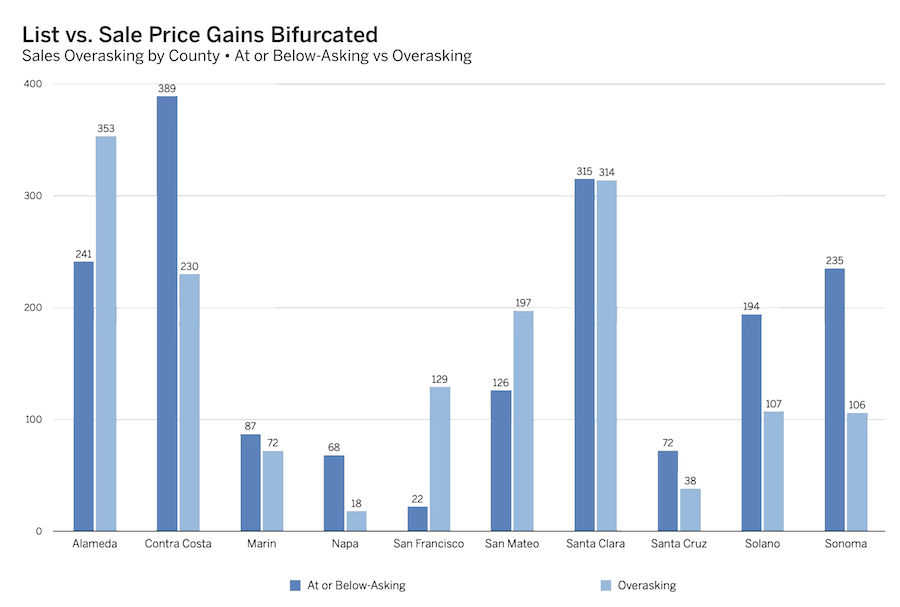
San Francisco Bay Area homes continued to sell quickly and often for well over the list price, highlighting that buyer demand continues to outpace supply. Homes sold in 34 days on average in August, and the average days spent on market decreased in nearly all counties. Notably, homes sold in less than four weeks in Alameda, San Francisco, San Mateo and Santa Clara counties, and more than half of homes sold for more than the asking price. Across the broader region, more than 45% of home sold for over asking, with sellers receiving 12% more than the list price, on average. Napa County lagged the region as average days on market neared three months and less than one-quarter of homes sold for more than the asking price.
PRICE GAINS BIFURCATED ACROSS REGION
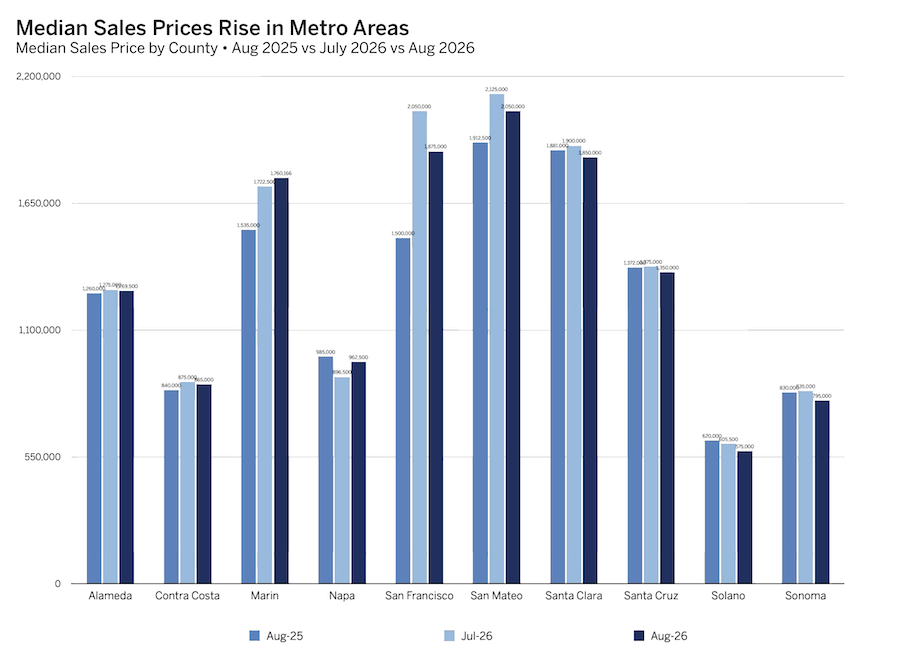
Overall, strong buyer demand and a limited number of homes available for sale put upward pressure on home prices. The median sales price in the San Francisco Bay Area increased by 2.1% year-over-year to $1.30 million. Price gains were bifurcated by county. The median sales price increased by 25% in San Francisco to $1.875 million, less than 10% off the all-time high, and price growth was also strong in adjacent Marin and San Mateo counties at 14.7% and 7.2%, respectively. Home prices were relatively stable in Alameda and Contra Costa counties, and declined in the remaining five counties. Some of the decline in Solano County may be attributable to the increase in sales of relatively lower priced homes.
LOOKING AHEAD
The regional housing market is likely to slow seasonally in September, before picking up slightly in October ahead of the holiday season when activity slows further. Additionally, geopolitical instability, inflation worries and selloffs in the U.S. Treasury market put upward pressure on interest rates, which subsequently affect mortgage rates. Interest rates, and thus mortgage rates, are likely to remain elevated in the near term, reducing affordability for potential homebuyers, especially those looking in the lower price segments. However, recent trends highlight that there is significant pent-up demand for homes in the San Francisco Bay Area. The potential for local firms to IPO in the near term, as well as other opportunities for employees to realize equity values, could further bolster the market this winter and into early 2027.
What My Clients Are Saying…
Marin Real Estate Market Stats
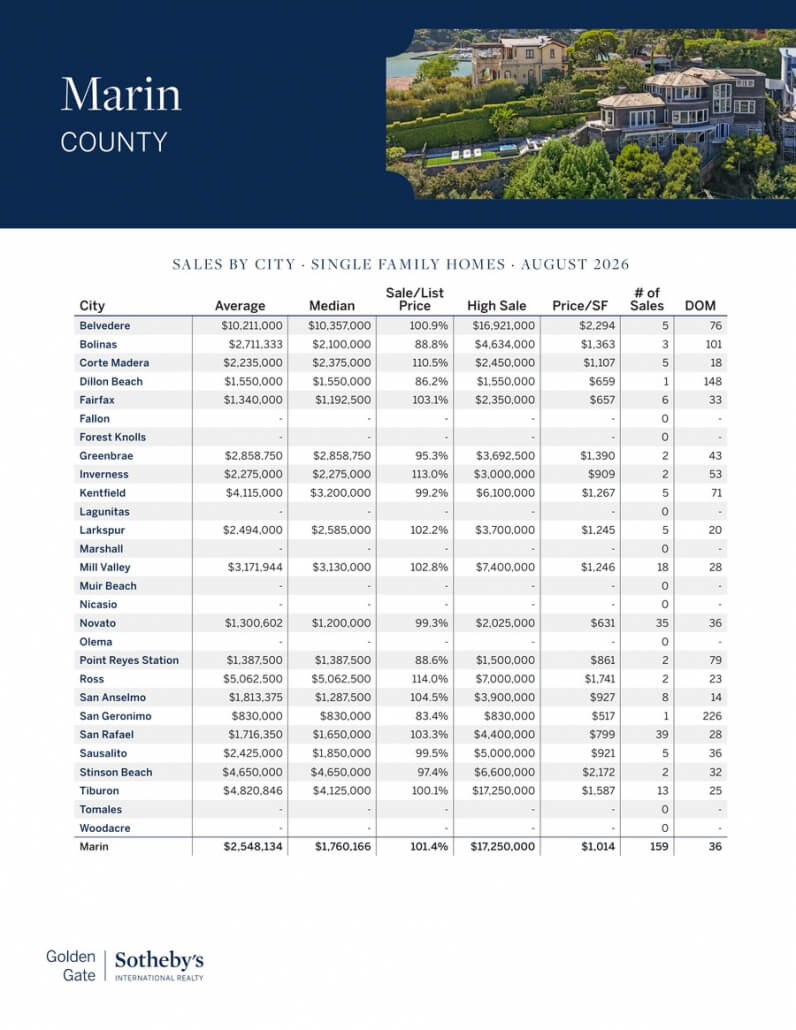
Marin County Real Estate Market Report Charts
(click any slide to enlarge & launch slideshow)
“For Sale” vs. Sold Home Prices vs. Median Home Prices
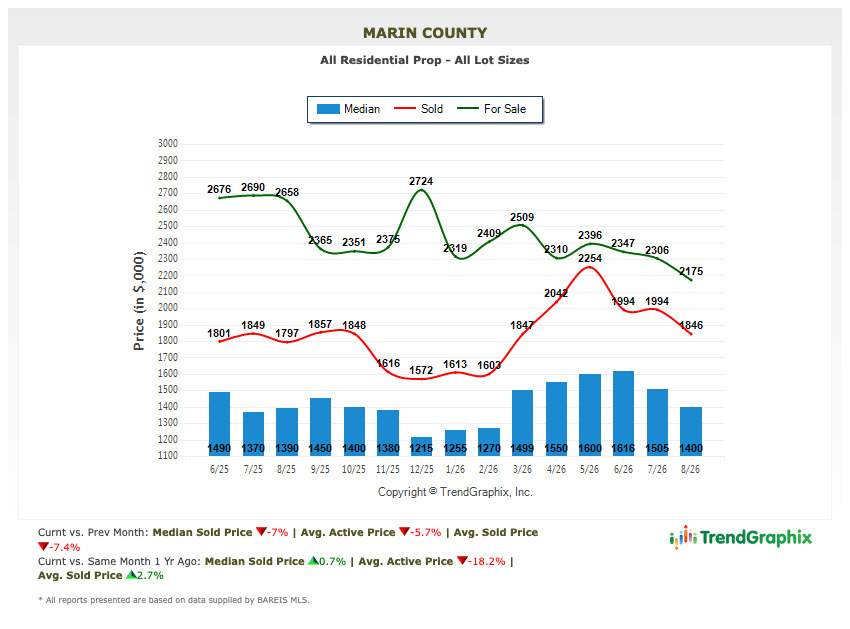
Marin Home Prices List Price vs. Sold
Marin County Months of Inventory Based on Closed Sales
Average Price Per Square Foot
Marin County Number of Homes on the Market
I hope you have found my Marin County Real Estate Market Report informative. Please feel free to add your comments, questions or suggestions in the comments section below. If I may be of any assistance in helping you attain your real estate goals, please call or text me at 415-847-5584 and I will be in touch right away.
Would you like to see this data for your town only?
I am also excited to announce that my website now has new real estate market reports by town with more coming soon. Please check these out:
Belvedere Real Estate Market Report
Corte Madera Real Estate Market Report
Fairfax Real Estate Market Report
Kentfield Real Estate Market Report
Larkspur Real Estate Market Report
Mill Valley Real Estate Market Report
Novato Real Estate Market Report
San Anselmo Real Estate Market Report
San Rafael Real Estate Market Report
Tiburon Real Estate Market Report
These are all accessible from the “Market Reports” menu item here on my website at any time.

About the Author
Thomas Henthorne is consistently top-ranked, award-winning real estate agent in Marin, helping people buy and sell homes for almost a decade. He writes the #1 real estate blog in Marin County and is a frequent speaker on panels at industry gatherings.
He may be reached at 415-847-5584.
Marin County Real Estate Markets Covered in This Report: Belvedere | Corte Madera | Fairfax | Greenbrae | Kentfield | Larkspur | Mill Valley | Novato | Ross | San Anselmo | San Rafael | Sausalito | Stinson Beach | Tiburon




Leave a Comment
What do you think?Please leave your comment below!